Start from the behavior
Before a single slide, I map the decisions someone actually has to make on the job — the moments where it goes right or wrong. Those moments become the course. Everything that doesn't change a decision gets cut.
I build scenario-based eLearning where the learner practices the decision itself: branching conversations, consequences that follow from the choice, and feedback that stays inside the story. Twenty years of designing assessment and training for working adults, now in Articulate Storyline.

Most training tells people what to do and then tests whether they remember it. That changes what they know. It rarely changes what they do.
Before a single slide, I map the decisions someone actually has to make on the job — the moments where it goes right or wrong. Those moments become the course. Everything that doesn't change a decision gets cut.
People act on what matters to them, not on what they've been told. My background is the psychology of professional activity, so I build scenarios that make the learner look for the motive underneath the stated request — and reward them when they find it.
A wrong answer costs something and the conversation keeps going. Learners who can always recover keep trying; learners who get locked out stop. Feedback lives in the character's reaction, not in a pop-up that says Incorrect.
Built end to end — needs analysis, action map, script, characters, visual design, branching logic, voice and audio.
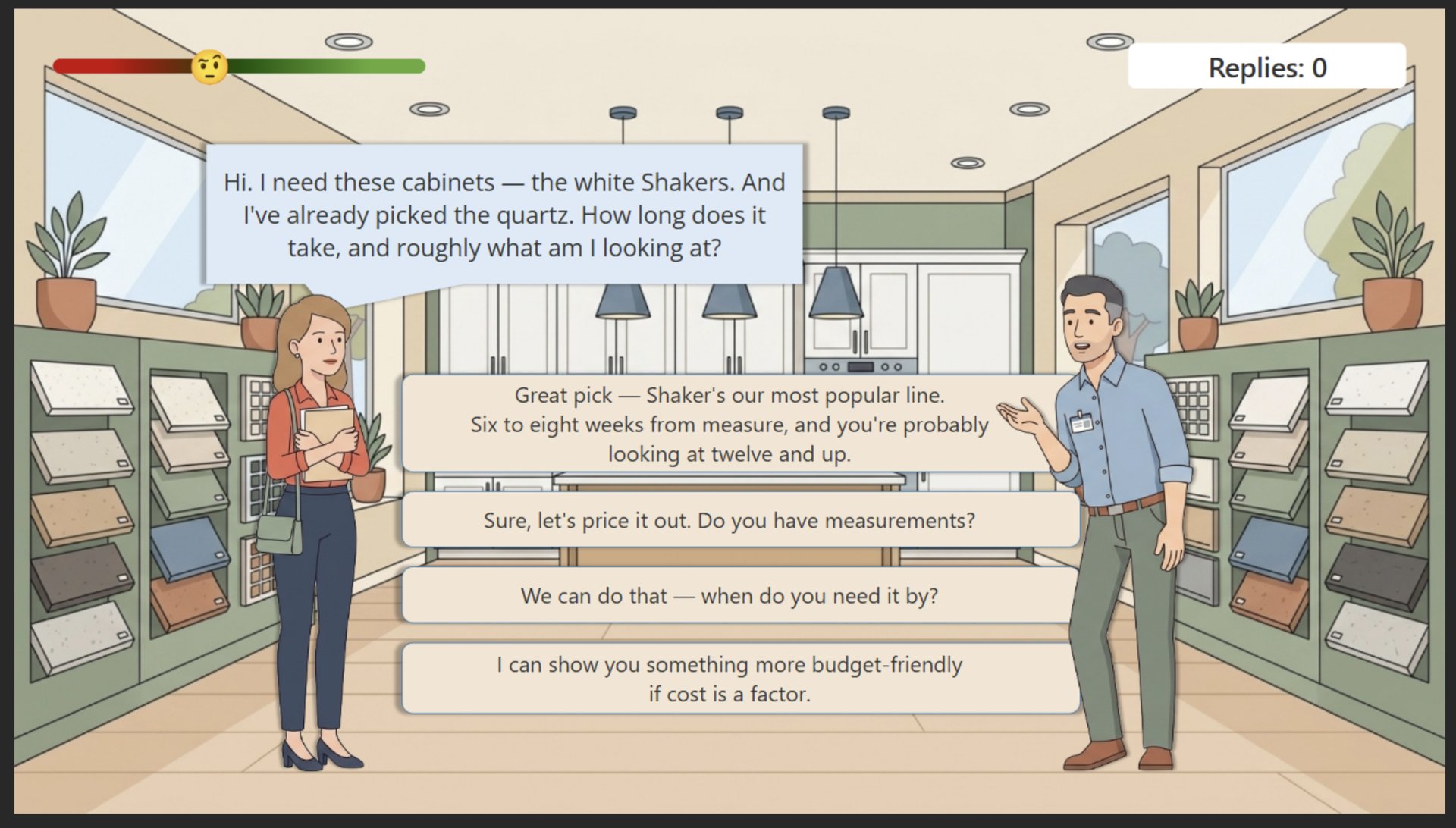
Scenario-based eLearning · Articulate Storyline 360
A branching sales simulation for a kitchen-remodeling showroom. Three customers walk in and say what they want. None of them says why they came. The learner has five replies per customer to find the real reason — and the customer's mood, patience and willingness to sign all move in response.
Fifteen decision screens, forty-five written consequences, three endings determined by how the whole day went. Every wrong reply gets its own answer from that customer, in their own voice, so feedback never reads as a verdict.
I'm Paul Lubo, an instructional designer in the Chicago area. I came to this work from the other end: I spent years studying how adults actually learn a profession, and then spent years building the systems that measured whether they had.
I hold a doctorate in psychology and taught in a university department of pedagogy and the psychology of professional activity, where my work was training people who were already working — and designing the instruments that showed what training had changed.
Along the way I set up a software and database testing laboratory accredited under the Russian national standards system, and built a university's quality-monitoring department and testing center from nothing — item banks, assessment procedure, reporting, the people to run it.
What carried over is a way of working: define the behavior first, design backward from it, and build something you can actually ship. What's new is the toolset — and that's what the work on this site is for.
If you have training that people complete and then don't use, that's a design problem — and it's the one I like working on. I'm open to instructional design and learning-experience roles, contract or full-time.